Adoption – Financial Considerations
Finances can be one of the most important considerations in adoption. Many do not consider adopting simply because of the cost. However, today, you can find various fostering and adoption programs that fit your financial situation.
- How much does it cost?
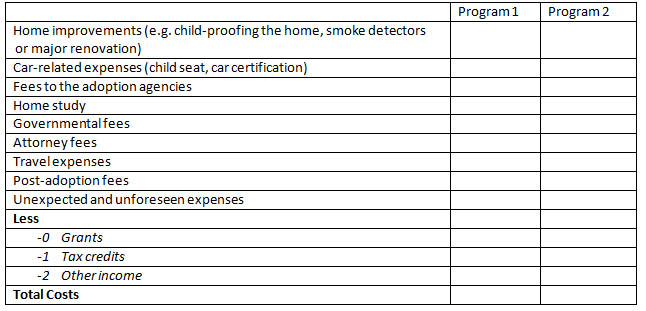
- The cost of an adoption program ranges from nearly free for some domestic government programs to over $40,000 for international adoptions. Even for international adoptions, the costs differ substantially from country to country. Most agencies provide you with a worksheet to calculate the cost for your adoption program. You can start a simple worksheet to compare the different programs in order to make sure potential programs fit your budget.
- In general, expenses do not occur all up front. Fees are paid for each stage of the adoption to your agency. Your agency can provide you with a timeline of when you can expect to pay these expenses.
- Financial worksheet example:
- What assistance is available?
- Federal adoption credits
- For most of you, federal adoption credits will be your biggest source of assistance. This credit is available for domestic (including foster adopt) and international adoptions.
- The 2008 adoption tax credit is $11,650. This is a one-time tax credit for each adoptive child. It goes up approximately 2% every year. In general, you can claim the credit starting the tax year that the adoption is finalized and your child becomes a U.S. citizen if he or she is not one already. Expenses incurred can be from the whole adoption process, not just the current tax year that you claim the credit. See below chart for an example of a family claiming this credit.
- Adoptive parents may take the same dependency exemption on their income tax for their adopted children and children placed with them for adoption, even if the adoption is not yet finalized.
- Eligible expenses and non-eligible expenses (ednote: ???)
- For an adoption of a special needs child, you can claim the full credit even if you do not have related expenses. The credit is up to the amount of your federal income tax owed. However, you can carry over the credit for up to 5 years. For example, if your tax owed is only $5,000 in 2008, you can carry the credit of $6,650 to your 2009 tax return for a total of the $11,650 amount mentioned in (ii). Please see the IRS publication for form 8839 below for the definition of a special needs child.
- The tax credit is non-refundable. This means if you do not owe any federal income tax in within the 5 years, you do not reap the benefits of the credit.
- There is an income limit as well. The credit will be reduced when your adjusted gross income is more than $171,820. If your income is greater than $210,820, there is no tax break for you. Unlike most other tax credits, the income limit is the same for singles and married couples. Also, Alternative Minimum Tax may make the matter even trickier. For specific situations, please read the IRS publication (http://www.irs.gov/pub/irs-pdf/i8839.pdf) and consult your accountant. James 1:27 can also provide assistance in this area as well.
- State tax credits
- Many states have their own form of tax credits for adoption. Some states offer extensive tax credits. Check with your state tax board for more information.
- In the state of California, the Child Adoption credit is more restrictive and is for special needs children only. This credit accounts 50% of qualified costs in the year that an adoption is ordered, up to $2,500. You can carry this credit in future years until the full credit is used.
- Eligible expenses include adoption fees, travel expenses, and other necessary expenses, such as medical expenses. You may also include expenses related to a prior unsuccessful attempt to adopt a different child. Unlike with the federal credit, attorney and court fees do not qualify.
- For the year in which an order of adoption is entered, you may claim credit for 50% of the cost of adopting a child who is a citizen or legal resident of the United States. Also, the child must have been in the custody of a California public agency. This also means international adoptions or out of state adoptions are not eligible for this state credit.
- Employee Adoption Assistance: Monetary assistance received from your employer
may not be counted as taxable income. Check with your employer for any adoption
benefits. These may include:
- Days off,
- Company matching or grants,
- Paid leaves similar to maternity leaves. This can be used in conjunction with state family leave benefit.
- Grants: Grants are very limited because of the high number of applicants. Many are limited to special and unusual needs, such as older, disabled, or hard-to-place children. Some of them may be available through your adoption agency. Other organizations such as Shaohannah’s Hope, founded by Steven Curtis Chapman (www.shaohannahshope.org), Life International (www.tmgfoundation.org), the Gift of Adoption Fund (www.giftofa doption.org) and I Care (www.intlcare.org) also provide grants. Please see the Affording Adoption (http://www.affordingadoption.com/grants.php) website for more listings.
- Loans: Adoption loans are available through certain adoption agencies. Your local banks or credit unions may be able to work out something with you. With the current credit market situation, loans can be hard to obtain. Also keep in mind that in the future, you will incur added expense for the child while paying back your loan. Try to consider an option that is within your means. Try to save rather than borrow. If you do you borrow, make sure you have the resource to repay.
- Get your family members, especially parents, on board. Be aware that money issues within the family can affect your relationship with them.
- Write support and prayer letters to your like-minded friends.
- Get a part-time job. Seasonal and flexible jobs are ideal, such as Frostbites .(ednote: I understand the sentiment behind this, but may want to change the example to something more general, like 'such as retail or food service'.)
- Full-time military personnel are eligible for a one-time subsidy program: $2,000 for the adoption of a single child and up to $5,000 per family per year.
- Federal adoption credits
More financial information can be found in domestic and international adoption articles. You can contact Jian Huang if you would like further information. Your questions and comments will also help us improve our resources here. Of course, those who have adopted previously are great resources as well.